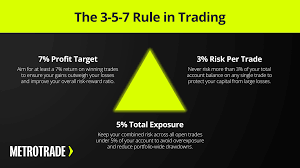
Forex trading is full of opinions.
Different strategies.
Different indicators.
Different styles.
But beneath all the variety, experienced traders tend to agree on a small set of core principles. These are not secret techniques or shortcuts. They are rules shaped by experience, discipline, and survival.
Ignore them, and losses often grow faster than expected.
Respect them, and trading becomes more controlled and sustainable.
Here are seven undeniable rules of forex trading that consistently stand the test of time.
Rule #1: Protect Your Capital First
Capital is the lifeblood of trading.
Without capital:
- No strategy works
- No opportunity matters
- No recovery is possible
Professional traders focus on capital preservation before profit. They understand that staying in the game is more important than winning any single trade.
Profits come later. Survival comes first.
Rule #2: Risk Management Is Not Optional
Every trade carries risk.
The question is not whether you will lose — it’s how much.
Undeniable truth:
- Small losses are manageable
- Large losses are destructive
Successful traders define risk before entering a trade. They know where they are wrong and accept that outcome calmly.
Risk management is not a defensive tactic — it is the foundation of consistency.
Rule #3: The Market Does Not Owe You Anything
One of the hardest lessons in forex trading is emotional.
The market:
- Does not care about your analysis
- Does not reward effort
- Does not remember past losses
Each trade is independent.
Traders who expect the market to “come back” or “make it right” often compound mistakes. Acceptance of uncertainty keeps decisions rational.
Rule #4: Consistency Beats Brilliance
You do not need to be clever to succeed in forex.
You need to be consistent.
A simple strategy executed with discipline will usually outperform a complex strategy executed inconsistently.
Consistency means:
- Following rules
- Repeating processes
- Accepting routine outcomes
Boring trading is often healthy trading.
Rule #5: Losses Are Part of the Business
Every trader loses.
The difference lies in how losses are handled.
Professionals:
- Accept losses quickly
- Learn from them objectively
- Move on without emotional attachment
Losses are operating costs, not personal failures.
The goal is not to avoid losses, but to avoid uncontrolled losses.

Rule #6: Discipline Matters More Than Strategy
Many traders fail with good strategies because discipline breaks down.
Discipline includes:
- Taking valid trades
- Skipping invalid ones
- Stopping when rules say stop
The best strategy fails if rules are ignored.
An average strategy survives when rules are respected.
Discipline turns plans into results.
Rule #7: Trading Is a Long-Term Skill, Not a Shortcut
Forex trading is not a race.
Skill develops through:
- Experience
- Observation
- Reflection
- Patience
Those who rush often repeat the same mistakes at higher cost.
Traders who treat forex as a long-term skill build resilience and realistic expectations.
Why These Rules Are “Undeniable”
Markets evolve.
Technology changes.
Strategies come and go.
But these rules remain relevant because they are based on human behavior, not market conditions.
Fear, greed, impatience, and discipline do not disappear.
The CEO Mindset: Trade Like a Decision-Maker
Successful traders think like executives.
They focus on:
- Process over emotion
- Risk over excitement
- Stability over speed
They manage trading like a business, not a bet.
What These Rules Will Not Do
These rules will not:
- Guarantee profits
- Eliminate losses
- Make trading easy
What they will do is:
- Reduce unnecessary mistakes
- Improve decision quality
- Support long-term consistency
Final Thoughts: Respect the Rules or Learn the Hard Way
Forex trading rewards those who respect structure and punishes those who ignore it.
The seven rules above are not exciting — but they are effective.
If you follow them, trading becomes clearer and more controlled.
If you ignore them, the market will eventually remind you why they exist.
In forex trading, discipline is not optional.
It is the price of participation.
End of article.
Summary:
This article goes into the 7 trading rules unanimously agreed upon by successful Forex traders. It starts off with a fun story that illustrates the concept of learning from others� mistakes then dives straight into the meat of the article. Very direct and precise. Are you following the trading rules?
Keywords:
Forex, Forex Trading, Technical Analysis, Mini Account, Trading, Leverage, Rapid, RapidForex, Investment, Business, Online, Charts, Trend, Charting
Article Body:
Before we go into 7 rules of Forex Trading, that have been approved by a number of full time and successful traders, I�d like to narrate this story.
There was a lion, a donkey and a fox all keen to go out rabbit hunting together. After a productive day of hunting, the three of them sit around the pile of rabbits and the lion asks the Donkey, �Mr Donkey, would you please divide the pile into equal shares for the 3 of us?�. The Donkey obliges and counts the rabbits into three equal piles for each of them. The Lion immediately roared and pounced him. He then piled all the rabbits on top of the donkey and asked the Fox �Mr Fox, would you please divide the rabbits up evenly between us?�. The Fox takes out 1 scrawny rabbit from the pile and puts it in a pile for himself then say �There you go, Mr Lion, that�s your pile� pointing to the large pile of rabbits. The lion says �Mr Fox, where did you learn to divide so equally?� and the fox says �The Donkey taught me.�
The moral of the story is to learn from others� mistakes. Now we proceed to our 7 rules. These are for you benefit as mentioned earlier, from experienced, successful traders.
Rules #1
Never risk any more than you can afford to lose, you will lose money, all traders do, make sure you�re not sacrificing anything else important in the process
Rule #2
Never risk any more than 2% of your margin trading account on a simple trade.
For mini account holders, 2% of $300 would be $6 so realistically you would need around $15 so you can make this 5%. As soon as your account size is big enough, make this 2%.
Rule #3
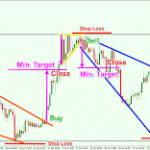
Always use a stop loss order.
If you haven�t figured out where your stop loss order and limit order should be at the start of your trade then you shouldn�t be trading.
Rule #4
Know your exit point before you enter a trade.
Rule #5
Demo Trade First: Become successful with paper trading when there�s nothing on the line before you open a real account.
Rule #6
Take a breather when your equity has taken a dive.
Rule #7
Don�t let your emotions call the shots: Stay cool, calm and collected. Patience and a clear head will win the game.
Tinggalkan Balasan